The Last Captain of the Caine
The Caine MutinyThe Last Captain of the Caine names Willie Keith at the close of the novel, when his rise to command meets the worn-down ship’s apparent last chapter. First used as a chapter heading and then returned to in the book’s final image, the expression makes “last” both a designation of Willie’s place in the ship’s history and a measure of how close that history is to ending. The author’s note stresses that the people and events aboard USS Caine are imaginary and that no ship of that name existed; the phrase belongs to the novel’s fictional world, not to an actual naval record.
The Phrase and Its Placement
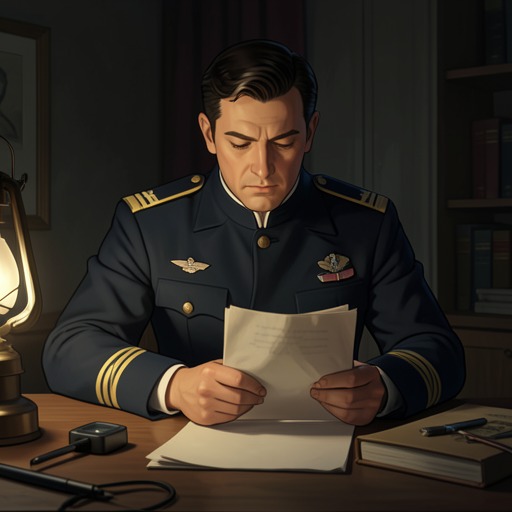
The expression appears as the heading of the final chapter, before Willie moves his belongings into the captain’s room. Its significance is therefore announced at the moment command becomes personal: he lies on the bunk associated with Philip Francis Queeg and understands that Queeg has become the defining historical figure in his life. The chapter heading gives the scene a retrospective cast. Willie has not merely received an assignment; he has arrived at the end of a succession of captains aboard the ship.
The same designation returns in the final sentence, where scraps of torn paper drift down and brush the face of the last captain of the Caine. The phrase thus encloses the ending: it begins as a chapter title and closes as an image attached to Willie. Rather than explain his future, that final recurrence fixes him momentarily between public history and private decision.
A Command Won in a Changing War
Willie’s appointment follows a career aboard a ship whose work rarely matches the grand scale of the war around it. At the beginning of 1944, broad accounts of the war could describe its outcome as already turning toward Allied victory, but Willie’s view from the Caine’s wheelhouse on New Year’s Eve was anxious and immediate. He imagined the dangers of the Pacific campaign, not the distance of later historical perspective.
The contrast between war’s vast machinery and the ship’s ordinary labor recurs in the episodes leading toward his command. In January, the Caine sailed from Hawaii with an enormous fleet bound for Kwajalein. At Funafuti Atoll, Willie went ashore to use a destroyer tender’s communications office, where fleet messages were decoded and mimeographed—work that relieved the burden on destroyer communicators. Seventeen days before the war’s end, the Caine finally swept a mine in the China Sea. These distinct duties place Willie’s eventual command within a service defined not only by battle but by messages, maintenance, and minesweeping.
The Ship’s Limits and Willie’s Pride
Willie takes command knowing that the Caine is a dirty, broken-down hulk. The ship’s condition had practical consequences: when destroyer-minesweepers were ordered to prepare for a Tokyo harbor-sweeping mission, the Caine was excluded. Willie and Tom Keefer tried to persuade the MinePac operations officer that the ship was ready, but he judged its condition too poor to risk another breakdown or a typhoon at sea. Their disappointment makes the captaincy an honor bounded by the vessel’s limitations; command does not erase the failures or restore the ship to readiness.
Even so, Willie experiences the appointment as a durable achievement. He recognizes that luck and merit are mixed in it, yet takes pride in having risen from fumbling beginnings to command of a United States warship. The name of the captain’s room intensifies that pride: it is still Queeg’s room in Willie’s mind, and Queeg remains the grand historical figure against whom he measures the institution and his own naval life. The title’s finality does not diminish Willie’s accomplishment; it gives that accomplishment a finite, particular setting.
The Ending’s Double Horizon
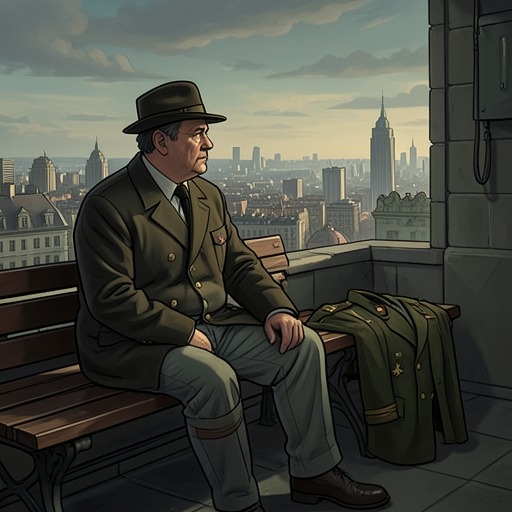
At the close, the public ceremony of marching sailors and the private prospect of marriage occupy Willie’s attention at once. He watches the Navy’s ranks pass, but feels no regret at standing on the sidelines. His mind is on the fight ahead and on making May Wynn his wife, although he does not know what life together will be like or whether they will be happy. The final designation therefore does not present Willie as simply the triumphant endpoint of a naval career. It holds together his pride in having commanded the Caine, the ship’s evident fragility, and a future whose shape remains unsettled.
The last image makes the expression a quiet frame for both endings: the Caine’s story and Willie’s wartime identity are reaching their limit, while his chosen life beyond the ship is only beginning. The scraps falling across his face connect the ceremony to the title without resolving what comes next. Willie is the last captain in the story’s closing moment, but the future the novel leaves him is not confined to that rank.